Living.Lab

Visitor Economics. Tourism economics

Tourism drives 10% of global GDP. Yet it is planned in silos. Living Lab connects the dots.

We align policy, investment and delivery into one strategy. OECD-aligned. In 80 countries.

Scroll Down

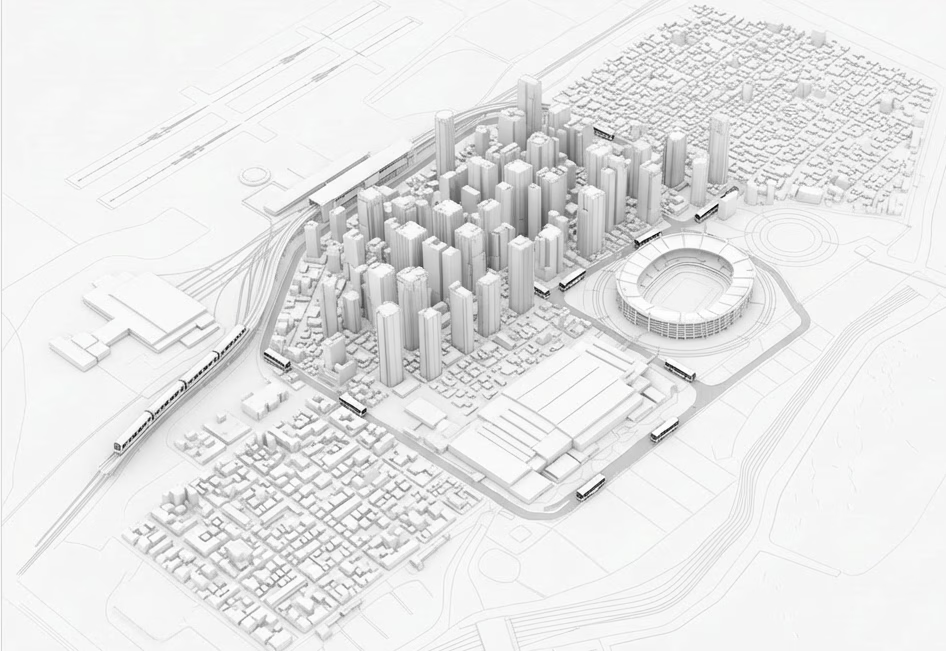
One visitor economy. Nine connected domains.

Tourism Economics Eco System
Airports & Routes

Connecting air routes to GDP, jobs and hotel demand

Selection of routes ... subsidies, slot allocations and bilateral agreements have economic consequences. Living Lab allows you to link air connectivity to long term FDI strategy, event attendance, hotel occupancy and fiscal return. 

Public Transport

Modelling how transport capacity shapes event attendance, precinct spend and fiscal return.

Transport networks set the ceiling on event attendance and determine where visitor spend lands. A visitor who steps off a tram into a walkable precinct passes retail frontages and F&B; a visitor who drives to a car park bypasses them entirely. Living Lab models modal shift economics, last-mile spend capture and service augmentation ROI — so transport, events and economic development plan from the same evidence base.

Sports & Live entertainment

Audit-ready economics for hosting decisions.

We show you how to build sports event portfolios that deliver for voters.  Hosting fees, venue investments and event bids require economic cases that survive treasury and parliamentary scrutiny. Living Lab models retained spectator spend, employment, displacement and legacy effects.

Cultural Venues

Proving the fiscal case for cultural investment.

Festivals, venues and cultural programming generate GDP, employment and tax revenue. Living Lab quantifies that contribution in terms treasuries accept: fiscal return, seasonal demand effects, hotel and F&B impact. The economic case and the cultural case become the same document.

Convention & Event District

Portfolio intelligence for convention bureaux.

Your MICE calendar is a strategic asset. We help optimise your meetings incentives conferences exhibitions portfolio and produce OECD-compliant impact models covering room nights, loading, exhibitor spend, counterfactuals and fiscal contribution.

Sponsor Activation

Attributing sponsor spend to measurable economic impact.

Sponsorship is public money in many government-supported events. We attribute sponsor spend to incremental revenue, tax and GVA using event-level modelling. The output tells you what the sponsorship delivered, not what it promised.

Hotels

Connecting hotel demand to the events and routes that drive it.

Hotel occupancy is not an independent variable. It is driven by events, air connectivity and seasonal demand. Living Lab models these connections: event displacement, occupancy smoothing, RevPAR effects and the fiscal contribution of accommodation. One model, shared across tourism and finance.

Short term rentals

Modelling STR policy with fiscal and displacement effects.

Licensing, zoning, occupancy caps and pricing decisions all have economic consequences. Living Lab models STR scenarios to show government how different policy settings affect hotel revenue, fiscal yield and housing supply – so regulation is evidence-led, not reactive.

Entertainment Economy

Quantifying the net fiscal contribution of the night-time economy.

The entertainment economy generates GDP, employment and tax. It also generates policing, transport and public-realm costs. Living Lab models the net contribution, so licensing, trading hours and zoning decisions increase fiscal yield while maintaining residential balance.

Living Lab answers “what should we do next?” not just “what happened?”

How does it work?

Step 1

Connect

Most governments begin with event portfolios and expand from there. We layer in visitor economy data: event calendars, route schedules, hotel supply, venue capacity, infrastructure plans and policy objectives. We need the decisions you are making and the data behind them. 

Step 2

Model

Living Lab integrates your data with proprietary datasets covering 80 countries and 200+ cities: hotel demand curves, air connectivity economics, fiscal frameworks, visitor spending profiles and employment multipliers.

Step 3

Decide

You receive evidence base structured for every department that touches the visitor economy. Finance reads fiscal return. Tourism reads visitor demand. Transport reads connectivity. Planning reads infrastructure economics. One model, one methodology, one set of assumptions – readable by every team

6 ways Living Lab strengthens government decision-making

    Living Lab Logo

    Living Lab Manage the visitor economy as a system.

    Book a briefing with Living Lab. We will walk you through the platform and show you how your visitor economy performs as a connected system – and where the unrealised value sits.

    FAQ - Living Lab for governments

    Standard input-output models produce a single backward-looking multiplier. They cannot model event cannibalisation, hotel displacement, seasonal effects or portfolio-level interactions between cultural events. Living Lab is purpose-built for the visitor economy: we model forward-looking scenarios across your full cultural calendar so you can test programming decisions before committing public funds. Where generic models answer ‘what happened?’, Living Lab answers ‘what should we programme next?’

    We require four inputs per event: dates, location, operating expenditure and international visitor count. Living Lab combines these with proprietary datasets covering hotel demand, air connectivity, fiscal frameworks and visitor spending profiles across 200+ cities. Once the data is ready, most single-event arts economic impact studies are delivered immediately unless a bespoke document format is required.  Multi-event arts economic impact studies are similar. Forecast studies depend largely on the complexity and scale of the project and data but plan for four weeks from sign off.

    Pricing depends on scope. A single-event hosting analysis is priced differently from a multi-event portfolio assessment or a full infrastructure life cycle model. Living Lab offers annual platform licences tiered by city count, event volume, and data modules, as well as standalone advisory engagements. We scope pricing on a briefing call so the engagement matches what you actually need to decide.

    Yes. Event organisers, venue operators and rights-holders use Living Lab to prove economic value to host cities, justify public subsidy, negotiate with arts councils and demonstrate ROI to sponsors and stakeholders. The methodology is the same whether the client is a government or an event owner. The difference is which outputs each buyer needs: governments focus on portfolio optimisation and fiscal return; event owners focus on proving the value their programming delivers.

    Yes. Every output includes a full assumption trail, sensitivity analysis (low, medium, high scenarios) and source documentation. The methodology is OECD-aligned and designed to meet the requirements of national audit offices, finance ministries and Big 4 accounting firms. We are explicit about additionality, displacement, leakage and counterfactuals: the areas where most economic impact claims fall apart under scrutiny.

    Living Lab operates across 80 countries and 200+ cities, with particular depth in the Gulf, Europe, Asia-Pacific and the Americas. If your city is not yet in our system, we can typically onboard it within the scoping phase. Our international coverage is built to the same methodological standard as our core markets: OECD-compliant and audit-ready at every level.

    Cultural portfolio optimisation is the process of managing a city’s full cultural calendar as a strategic economic asset rather than a list of individually funded events. Living Lab analyses interactions across your portfolio: which festivals cannibalise each other, where calendar gaps leave hotel inventory idle, which art forms attract the highest-value international visitors and where the fiscal return per pound of public investment is strongest. The result is a calendar that maximises total economic contribution, not individual event attendance.

    IMPLAN is a general-purpose input-output modelling tool built for the US domestic economy. Living Lab is purpose-built for event and tourism economics, covers 80 countries at city level and delivers forward-looking portfolio intelligence rather than a backward-looking multiplier report.

    A standard engagement produces GDP contribution (direct, indirect, induced), employment supported (FTE), fiscal return to government, hotel room-nights generated, visitor spending analysis and portfolio-level scenario modelling. All outputs include assumption documentation, sensitivity ranges and source references. Reports are structured for ministerial briefings, grant submissions and treasury papers, not press releases.

    Yes. Forward-looking scenario modelling is core to the platform. We can model the economic case for a new festival, a venue expansion or a change in cultural programming strategy, including incremental visitor spend, hotel demand effects, air route activation and fiscal return. We also model cannibalisation risk against your existing calendar and displacement effects on the host city. The output is a decision-grade business case, not a marketing brochure.

    FAQ - Cultural event tourism and economic impact

    A cultural event economic impact study measures the contribution of festivals, exhibitions, performances and cultural programming to a host economy. A rigorous study goes beyond attendance figures to quantify GDP contribution, employment, fiscal return, hotel demand and supply-chain effects. The best studies are OECD-compliant, assumption-transparent and built for government scrutiny: not a headline number, but a decision-grade economic case that can withstand audit.

    Arts and culture generate significant global economic impact, contributing over $2.25 trillion in revenue and supporting nearly 30 million jobs worldwide. Cultural and creative industries (CCIs) act as major drivers for tourism, local business revenue, and innovation, with U.S. arts and culture activity alone reaching $1.17 trillion in 2023.
    Key economic impacts include:
    • Job Creation & Economic Activity: Nonprofit arts organizations alone generated $151.7 billion in economic activity in 2022, supporting 2.6 million jobs and providing $29.1 billion in tax revenue.
    • Tourism & Ancillary Spending: Cultural events, museums, and festivals drive tourism. Attendees spend an average of over $30 per person per event on dining, parking, and transportation, which boosts local commerce.
    • Sector Growth: Arts and cultural economic activity has grown faster than the overall economy in recent years.
    • High Self-Employment: The sector supports high rates of self-employment, with artists and creative professionals being 3.6 times more likely to be self-employed than other workers.
    • Innovation: The creative sector drives innovation with strong links to other sectors like digital media and design, such as in web publishing and gaming.
    This sector is considered a strategic investment for economic, social, and environmental outcomes, providing a resilient, high-growth, and, often undervalued, component of the global economy.

    A credible study requires event-level data (dates, location, attendance, expenditure), robust economic modelling (input-output tables or computable general equilibrium models) and transparent assumptions. The model should account for additionality (what spending would not have occurred without the event), displacement (crowding out of other visitors), leakage (spending that leaves the host economy) and counterfactuals (what would have happened otherwise). Studies that omit these adjustments routinely misstate impact.

    Direct impact is the initial spending by delegates, exhibitors and organisers within the host economy. Indirect impact captures supply-chain effects: the hotel buys linen, the linen supplier buys cotton. Induced impact reflects the household spending of workers employed through direct and indirect activity. A credible study reports all three separately and is explicit about the multiplier assumptions used to estimate indirect and induced effects.

    Three factors can drive variance. First, methodology: studies using gross output rather than Gross Value Add (GVA) produce larger numbers. Second, additionality: studies that count all visitor spending without removing domestic sourced activity and adjusting for displacement or substitution overstate impact. Third, geographic and economic boundary: whether a study draws its boundaries at national or regional level fundamentally changes the result. A national study captures spending that recirculates across the wider economy; a regional study counts only what stays within the host city or region. The most reliable studies use GVA, adjust for displacement, define their geographic scope explicitly and publish sensitivity ranges.

    Seasonal backfilling uses cultural events to fill periods of low tourism demand. A festival programmed in a traditionally quiet month can justify air route continuation, support hotel rate stability and generate fiscal return that far exceeds the programming cost. For destinations with pronounced seasonality, cultural events are among the most cost-effective tools for smoothing annual demand curves and improving the economic performance of tourism infrastructure year-round.

    Governments should measure cultural event ROI against the public expenditure used to support events and programming: arts council grants, venue subsidies, marketing spend and infrastructure investment. The return should be expressed as fiscal contribution (tax revenue generated) relative to public cost, not as gross economic impact or attendance. A robust framework also accounts for opportunity cost: what else could the public money have funded, and would that have generated greater economic return?

    Hotel displacement occurs when an event fills rooms that would have been occupied by other visitors, meaning the net room-night gain is lower than the gross figure. In high-occupancy periods, displacement can be substantial. A credible study models occupancy patterns before, during and after the event to estimate net rather than gross hotel demand. Ignoring displacement is one of the most common sources of overstated economic impact in cultural event analysis.

    Additionality measures the economic activity that would not have occurred without the event. Not all visitor spending is additional: some attendees would have visited the city regardless (time-switchers), some are local residents who would have spent money elsewhere in the economy (casuals). A rigorous study estimates the proportion of genuinely additional visitors and adjusts the economic impact accordingly. This adjustment is essential for any analysis intended for government decision-making.

    Cultural events serve as anchor demand for destination development: they justify air route investment, underpin hotel development feasibility, fill seasonal troughs in occupancy, raise destination profile and attract high-value visitors whose per-day spend often exceeds that of leisure tourists. For governments developing tourism strategy, cultural events provide predictable, programmable demand that can be planned years in advance, shaped to fill specific economic gaps and aligned to national strategic priorities in ways that leisure tourism cannot.

    Living Lab is the tourism operating system for governments, events, cities, and infrastructure owners.

    We provide government-grade economic intelligence across MICE, Sports and Cultural events, aviation, accommodation, and public investment — enabling joined-up tourism strategy and destination development.

    © We are Living Lab Ltd 2026

    Core Capabilities

    • Event economic impact

    • Economic impact studies

    • Tourism strategy

    • Destination development

    • Visitor economy modelling

    Where We Work

    • 80 Countries

    • 226 Cities

    • MICE events

    • Sports events

    • Cultural events

    • Aviation Route development

    • Tourism systems

    • Public investment and infrastructure

    • Rights holders and hosting

    Living Lab Ltd
    Registered in the United Kingdom
    Company number SC848549

    Microsoft Partner

    Our economic impact and tourism system models align with OECD statistical standards and support reporting against the UN Sustainable Development Goals (SDGs), including productivity, employment, and sustainable urban development.