Real Estate Economics
Real estate economic impact build the case that supports building the asset
Your asset is valuable, the approval process demands a stronger case. Living Lab builds it.


Your asset is valuable, the approval process demands a stronger case. Living Lab builds it.
A decision-grade economic case is the fastest route through the approval chain.
GDV
in client development
Delays start with government. 79% of builders cite permitting and regulatory approvals as the primary cause of project delays. (NMHC/Swiftlane)
Each month of regulatory delay cost 1–3% of total project value. A six-month stall on a US$100m development cost US$18m. (LAI Design Group/ULI)
Only one in four projects comes within 10% of their original deadline.
(KPMG Global Construction Survey)
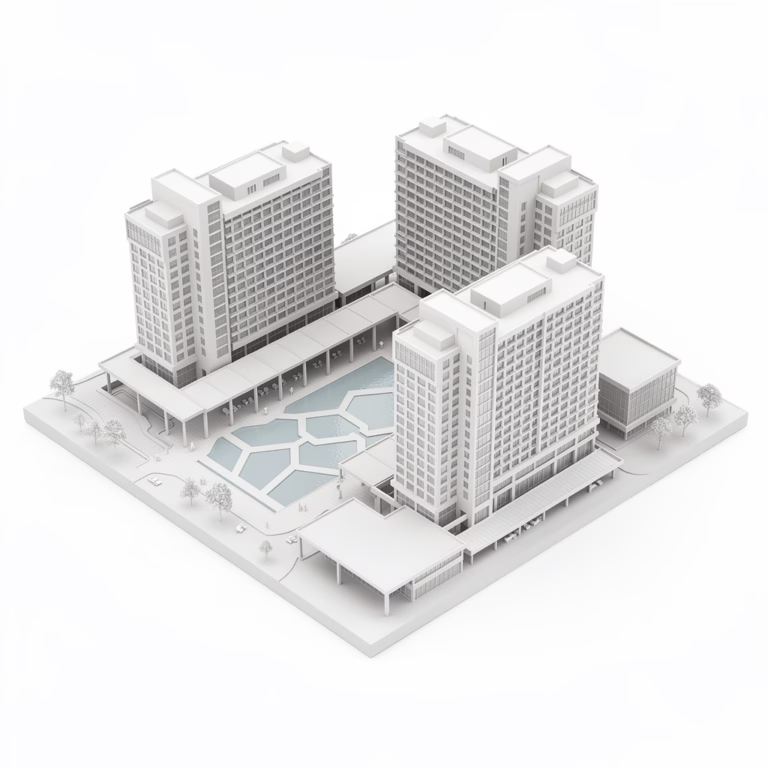
Destination-facing real estate shapes economies for decades. A hotel anchors visitor demand, fills off-peak calendar gaps and generates fiscal revenue long after the construction programme ends. A stadium attracts international fixtures, activates air routes and builds the city’s competitive positioning. An entertainment district creates a new demand centre that lifts property values, employment and visitor spend across the surrounding economy.
The economic case for these assets has never been more important. Planning authorities now expect lifecycle fiscal return, not a construction-phase summary alone. ESG-mandated investors require climate risk integration as a condition of financing. Treasuries want displacement analysis, sensitivity testing and transparent assumptions they can defend under audit. The bar has risen because the decisions are larger, more scrutinised and more competitive.
An economic impact study is only as valuable as the decision it unlocks. Living Lab builds the case that planning authorities approve, treasuries defend and audit offices sign.
For every asset – hotel, stadium, entertainment district, convention centre, mixed-use precinct – we model GDP contribution, employment, fiscal return and visitor economy effects across the full lifecycle: construction, operations and legacy.
The output is structured for the audiences that matter: a fiscal return calculation for the treasury, a net impact analysis for the planning board, a scenario-tested investment case for the lender. One model serves the full approval chain.







Share your development details: asset type, location, capital expenditure, construction timeline, intended use and expected operating profile.
Living Lab combines your data with proprietary datasets covering hotel demand, air connectivity, fiscal frameworks, hotel supply and pricing, ticket pricing etc, and visitor spending profiles. We generates GVA contribution, employment, fiscal return, hotel demand impact and portfolio-level analysis, adjusted for additionality, displacement, leakage and counterfactuals.
Receive a decision-grade economic case structured for planning submissions, treasury reviews, investor presentations and public consultation. Every number includes a source reference, sensitivity range and explicit treatment of additionality, displacement and leakage. The output is an economic case built to be challenged, and to hold.
Developer
‘I need planning approval and I need it fast. Show me the fiscal return, the net impact and the sensitivity range – in a format the treasury will sign off on.’
Hospitality investor
‘What does the event calendar do to occupancy? What does climate risk do to the asset? Give me numbers my board will back and my lenders won’t question.’
Planning authority
‘Tell me what this development adds to the city over 25 years. Net of displacement. Tested against downside. With every assumption I can read and defend.’
Living Lab models the full lifecycle of destination-facing real estate: construction employment and supply-chain effects, operational economics once the asset is functioning, and long-term legacy impact on the visitor economy and fiscal base. We model your development within the visitor economy system, connecting hotel economics to event demand, stadium viability to air connectivity, and mixed-use performance to seasonal visitor patterns. The output answers the question planning authorities and treasuries will ask: what is the 20-year economic return, what does it contribute to the city, and under what conditions does it succeed?
We require the project’s location, capital expenditure, construction timeline, intended use (hotel, stadium, entertainment district, convention centre, mixed-use, waterfront, resort) and expected operating profile. Living Lab combines these with proprietary datasets covering hotel demand, air connectivity, event calendars, fiscal frameworks and visitor spending profiles across 200+ cities. For ESG-integrated assessments, we incorporate climate hazard exposure data, energy performance benchmarks, regulatory timelines and adaptation cost estimates.
Yes. Forward-looking scenario modelling is core to the platform. We model proposed hotels, stadia, entertainment districts and mixed-use developments against the destination’s existing visitor economy. The output is a decision-grade investment case: GDP contribution, employment, fiscal return, visitor demand impact and climate risk profile across multiple scenarios. This is how development investment should be evaluated: before the capital is committed and the planning application is submitted.
Living Lab models the fiscal return to government (property tax, sales tax, employment tax, tourism levies) relative to the public expenditure requested: capital subsidy, tax incentive, TIF financing, infrastructure contribution. The output is structured for planning submissions and treasury review: every assumption documented, every source referenced, every sensitivity range explicit. This is the economic case that earns the concession and gives government the evidence to defend the decision publicly.
Not Yet. We are modelling physical risks (flood, heat stress, sea-level rise) and transition risks (energy performance standards, carbon pricing, embodied carbon regulation) are integrated into the economic model as standard. The OECD (2025) reports that 67% of real estate stakeholders view minimum energy and carbon performance standards as the most effective lever for sustainable investment. The ECB’s climate stress tests show commercial property in high flood-risk areas could lose up to 43% of value. For developers seeking ESG-mandated capital or responding to planning authorities with sustainability requirements, we will strengthen the investment proposition and accelerates financing decisions.
Yes. Every output includes a full assumption trail, sensitivity analysis (low, medium, high scenarios) and source documentation. The methodology is OECD-aligned and designed to meet the requirements of national audit offices, finance ministries, Big 4 accounting firms and institutional investment committees. We are explicit about additionality, displacement, leakage and counterfactuals: the areas where scrutiny is most exacting.
General-purpose input-output tools produce construction-phase snapshots using generic I-O tables. They serve a valuable function for domestic economic analysis. Living Lab adds three capabilities specific to destination-facing real estate: lifecycle modelling across construction, operations and legacy phases; visitor economy integration connecting your asset to event demand, air connectivity, hotel markets and seasonal patterns; and ESG and climate risk modelling embedded in the economic case. Living Lab covers 80 countries at city level and delivers forward-looking scenario intelligence alongside retrospective reporting
Pricing depends on scope. A single-asset lifecycle analysis for a hotel or stadium is priced differently from a multi-asset portfolio or entertainment district masterplan. Living Lab offers annual platform licences tiered by city count and data modules, as well as standalone advisory engagements for specific development decisions. We are happy to scope pricing on a briefing call.
A standard engagement produces GDP contribution across all lifecycle phases (direct, indirect, induced), employment supported (FTE), fiscal return to government (tax revenue by category), visitor demand impact (hotel occupancy, event-driven spend, air connectivity effects), displacement and additionality analysis, ESG and climate risk assessment, and scenario-tested sensitivity ranges. All reports include assumption documentation and source references. Outputs are structured for planning submissions, treasury reviews, investor presentations and public consultation.
Living Lab operates across 80 countries and 200+ cities. Real estate analysis uses the same city-level economic models, hotel demand data, aviation datasets, event calendars and fiscal frameworks that underpin our MICE, sports, cultural events and infrastructure intelligence. If your development location is not yet in our system, we can typically onboard it within the scoping phase.
Living Lab is the tourism operating system for governments, events, cities, and infrastructure owners.
We provide government-grade economic intelligence across MICE, Sports and Cultural events, aviation, accommodation, and public investment — enabling joined-up tourism strategy and destination development.
© We are Living Lab Ltd 2026
Event economic impact
Economic impact studies
Tourism strategy
Destination development
Visitor economy modelling
80 Countries
226 Cities
MICE events
Sports events
Cultural events
Aviation Route development
Tourism systems
Public investment and infrastructure
Rights holders and hosting
Living Lab Ltd
Registered in the United Kingdom
Company number SC848549
Microsoft Partner
Our economic impact and tourism system models align with OECD statistical standards and support reporting against the UN Sustainable Development Goals (SDGs), including productivity, employment, and sustainable urban development.