
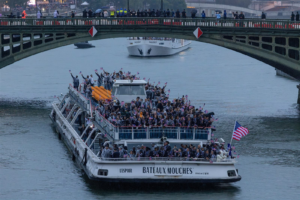
Seven countries bid for 2036: what a Games delivers to its host
Hamburg, Rome and Budapest pulled out of the 2024 race. This time the field is full, and each bidder can build its case on what it has already hosted.
A major event is one of the fastest ways a city turns a weekend into jobs, room nights, and investment. Living Lab shows what each edition delivered, how the property is growing, and what the next host should expect, on the same numbers.
One model of the event and everything around it: the host city’s routes and seat capacity, its hotel supply and rate in the event week, the calendar it sits in, and the search interest and sentiment in each fan market. Signal137 measures what the last edition delivered to the host economy, net of displacement, so the property’s value is visible edition over edition. Demand137 shows what the next edition or a new host city will return before the contract is signed. The rights holder negotiates on evidence the other side of the table can audit.

What the last edition delivered to the host economy: visitor spend, room nights, GVA, tax, and jobs, attributed to the event and net of what the city would have seen that weekend anyway. Fan origin by market and how they travelled, so the markets with the most headroom are visible. Which hospitality tiers sold through and where the premium held. Sentiment in the fan markets over the build-up and the weekend. Edition over edition, on one method, so the renewal case is a growth trajectory.

Candidate host cities ranked on what they can physically deliver: seats on the routes, rooms in the week, the last mile to the venue. Sales pacing against the archetype, with the finish forecast while there is still time to lift it. Every projection shown with its observed and inferred split, so a forecast is never presented as a measurement. The hosting fee priced against the return, so both sides sign a deal that pays.
| Product | Your question | You get | What it changes |
|---|---|---|---|
| Demand137 | Whether to bid for or fund a hosting opportunity, and at what level | A bounded scenario range with a stated counterfactual, not a single headline figure | A funding position defensible at audit and at the estimates |
| Demand137 | Which events to prioritise across a bid calendar | Every candidate event ranked on return, net of displacement, on one method | A portfolio that spreads risk across events |
| Demand137 | What the legacy commitment has to add to justify its own cost | The legacy-backed case set against the base event | The legacy commitment is priced |
| Demand137 | What happens if we do nothing? | Base, downside, and supported scenarios with a stated counterfactual | The cost of sitting the cycle out is priced alongside the cost of bidding |
| Demand137 | Will the supply chain cope, or will the value leak? | Absorptive capacity by supply chain: beds, drivers, caterers, airlift | The kegs, the beds, and the flights are sized before the fans arrive |
| Signal137 | What did the event actually deliver, net of what would have happened anyway? | Attributed GVA, tax, jobs, and room nights, with displacement and leakage stated | A legacy figure built to survive scrutiny |
| Signal137 | How does the tournament compare with the ordinary calendar? | The one-off event beside a full year of business events, on one method | The flood and the tide compared, so the next bid is priced on evidence |
| Signal137 | Which hotels saw the rate premium, and which saw none? | Per-hotel measurement, not a city average | Decisions made city by city, not on a national average |
| Signal137 | Did we deliver the carbon and ESG commitments in the bid? | Measured emissions and sustainability performance against what was declared | Performance reported the way it was committed to |
| Both | Who holds this, and where? | Model, data, and a trained team inside your jurisdiction | The capability survives the change of official or consultant |
GVA, tax, jobs, and retained visitor spend modelled for the specific city. The rights holder arrives at the negotiation with a number the city’s treasury can verify, and a fee that reflects what the event is worth to them.
Search interest and sentiment in each fan market, read against the calendar and the origin and travel data. The markets where the audience is growing, and the ones where a route, a package, or a campaign would bring more of them.
Every edition runs on the same method, so the trend can be checked. The renewal pitch is built on a growth trajectory, and the next edition is planned to extend it.
Cities ranked by hotel capacity, route connectivity to your event’s core audience markets, calendar position, and projected economic return. The rights holder sees which cities the property would grow in most, and negotiates from that list.
Attribution from the most recent edition: what the event delivered net of displacement, set against what the city invested. Both sides see the return, and the renewal is sized to grow it.
BY SECTOR
BY USE CASE
Hamburg, Rome and Budapest pulled out of the 2024 race. This time the field is full, and each bidder can build its case on what it has already hosted.
Manchester United’s proposed stadium is a £2bn, 100,000-seat ground by Foster + Partners, with a target opening of 2030-31. The club and the regeneration case cite £7.3bn a year for the economy and 92,000 jobs. Those are the promoters’ projections. Here is what to test before believing them.
At the Italian Grand Prix, the fleet of guest vehicles arrives on German plates with German drivers. The hospitality guests do not sleep in Monza, which hosts the race. They sleep in Milan, which does not. The town that pays captures a fraction of what the event generates.
On 13 June 2026 Scotland played Haiti at Gillette Stadium. Around 50,000 Scottish supporters travelled. Boston’s bars sold beer at roughly four times the volume of a Fourth of July weekend, and some ran dry. Every signal that would have warned them was visible weeks ahead.
We turn messy event and tourism data into decisions that help communities grow. Bring curiosity and rigour. We will hand you questions nobody has answered yet.