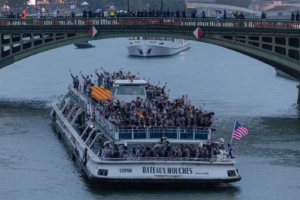
Seven countries bid for 2036: what a Games delivers to its host
Hamburg, Rome and Budapest pulled out of the 2024 race. This time the field is full, and each bidder can build its case on what it has already hosted.

Manchester United’s proposed stadium is a £2bn, 100,000-seat ground by Foster + Partners, anchoring a regeneration of the Old Trafford area. Manchester United stadium economics turn on three questions, and the answers are where the value sits: how many seats the demand fills every week, what the district does on the other 300 days, and how the £7.3bn is stated so the treasury adopts it.
The stadium would sit on the Old Trafford site at a reported cost of £2bn, with a target opening for the 2030-31 season. It would be the largest football ground in Britain and the second largest in Europe. The wider regeneration case, covering a one-million-square-metre brownfield site, cites 17,000 new homes, 92,000 jobs, and £7.3bn a year for the economy. Those are the promoters’ projections, produced for the case. They describe a prize worth testing, because a projection that passes the test can support the case for public money to build it.
Living Lab’s advice to every stadium client is the same. Build one fewer seat than you can sell. A full ground every week holds ticket prices and keeps the atmosphere that sells the broadcast. Manchester United has a vast global fanbase, and most of it is a long way away. A match draws a few thousand international travelling fans at most. The in-stadium product is for people who can get there on a Saturday. Size the capacity to them and it sells out for thirty years.
Dead seats send ticket prices down and cost a lot to maintain.
Mark Alexander, Living Lab
Liverpool expanded Anfield from about 45,000 to over 61,000 seats. Most of the additional seats went to members rather than to new season-ticket holders, which prioritised yield and changed the relationship between the club and its own supporters. It is a legitimate commercial choice, and a 100,000-seat ground makes the same choice at a larger scale. Design the ticketing strategy with the same care as the architecture. It decides the stadium’s revenue, so it should grow yield and keep the supporters.
An annual contribution of that size is a footprint claim. It gains weight when it states what it includes, over what geography, and how much would have happened anyway. The homes and the jobs come with the regeneration, and the stadium is the reason it is happening now. Show the two cases separately. Displacement stated: matchday spend that moved from elsewhere in Greater Manchester, set apart from spend that is new to the region. And the dark nights planned for: a 100,000-seat ground is used perhaps 30 times a year, and the district that works on the other 300 is where the regeneration pays back.
The proposal could be the best stadium in the world, and the regeneration could matter more than London 2012 did. Both are possible, and both can be shown. The mayor is seeking over £200m of public money for the regeneration. A public-value case that survives scrutiny turns that ask into an investment. The method is on the pages for venues and operators and public value and fiscal return. For further reading, see the Greater Manchester regeneration case.
Put those three questions to any stadium proposal. A proposal that answers all three makes the case for the district as well as the ground.

Hamburg, Rome and Budapest pulled out of the 2024 race. This time the field is full, and each bidder can build its case on what it has already hosted.
A hotel, a resort, or a mixed-use scheme fails underwriting when a single route, a single annual event, or a single source market turns out to be carrying more of the demand case than the committee realised. The dependency is the risk, and it can be measured before signature.
A race track, an arena, a stadium: each is built for a peak it reaches a few dozen times a year. The gap between peak and off-peak operational need is the commercial challenge behind every sports-anchored development, and the reason mixed use is the answer rather than the fashion.
Manchester United’s proposed stadium is a £2bn, 100,000-seat ground by Foster + Partners, with a target opening of 2030-31. The club and the regeneration case cite £7.3bn a year for the economy and 92,000 jobs. Those are the promoters’ projections. Here is what to test before believing them.
The owners of the Bulls and the Blackhawks are putting a reported US$7bn into 55 acres around the United Center: housing, a music hall, a hotel, retail, a park. The arena already hosts more than 200 events a year. The question a developer should ask is what the other 165 nights are worth.
At the Italian Grand Prix, the fleet of guest vehicles arrives on German plates with German drivers. The hospitality guests do not sleep in Monza, which hosts the race. They sleep in Milan, which does not. The town that pays captures a fraction of what the event generates.
BY SECTOR
BY USE CASE