
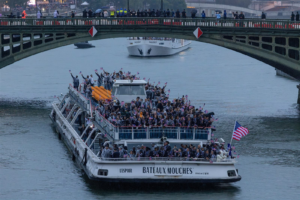
Seven countries bid for 2036: what a Games delivers to its host
Hamburg, Rome and Budapest pulled out of the 2024 race. This time the field is full, and each bidder can build its case on what it has already hosted.
A festival turns a few days into local spend, jobs, and a reason for the place to be known. Living Lab shows what each edition delivered to the town, how it is growing, and what a new site or strand would add, on the same numbers.
One model of the festival and its town: the routes and rooms that carry the audience, the calendar it sits in, the local businesses that serve it, and the search interest and sentiment in each audience market. Signal137 measures what the completed edition delivered, in economic terms and in participation, so the festival’s growth is visible to every funder. Demand137 shows what a new site, an expanded strand, or a date move would add before it is committed. The funding case is stated in the terms an arts council and a treasury both read.

What the completed edition delivered: audience spend, room nights, GVA, tax, and jobs, net of displacement and attributed to the festival. Audience origin, first-time attendance, and dwell in the town, so the markets with the most headroom are visible. Which local businesses captured the spend and which strands drew the audience that stayed. Sentiment across the audience markets before and after. Edition over edition, on one method, so the trajectory backs the funding case.

What the next edition, a new site, or an added strand will add. The access ceiling for the town in the festival week: the routes, the rooms, the transport to the site, and where added capacity lifts it most. Candidate dates scored against the calendar, holidays, and weather, with the binding constraint named. Ticket sales are paced against the archetype, so marketing can act in time to lift the finish. Every number marked observed, derived, or inferred.
| Product | Your question | You get | What it changes |
|---|---|---|---|
| Signal137 | What evidence goes into the grant renewal or board paper? | Cultural, public, and economic value reported together, each with its own measure | One funding case every stakeholder recognises |
| Signal137 | Did the expanded headline programme buy value, or only day-visitor spend? | Attributable value against a stated counterfactual, beside participation and commissioning share | Programme decisions made on what each strand contributes, not its visibility |
| Signal137 | How do we answer a challenge that public money should go elsewhere? | A traceable path from source and assumption to result, including what happens without the festival | A defensible answer |
| Signal137 | Does measuring economic value undermine the cultural argument? | The economic figure reported beside participation, commissioning, and community indicators, not instead of them | The festival is assessed on several measures, not reduced to one number |
| Signal137 | What did the festival do to the neighbourhood that hosts it? | Event cadence, accommodation pressure, and resident sentiment for the defined area | The community's question answered on the same evidence as the funder's |
| Signal137 | Did we meet the sustainability commitments in the funding agreement? | Carbon, waste, and community-impact data on the same cycle as the value case | One report answers the funder and the sustainability requirement together |
| Demand137 | Will the new site cope with the audience? | Visitor-flow and capacity forecast for the specific venue scenario | The site is tested before the programme is announced |
| Demand137 | Which weekend should the festival move to? | Displacement and capacity by date, with the shoulder weeks priced | The date is chosen on what the place can absorb |
| Both | Our funder's template still asks for a single impact total. Does this replace it? | The attributable economic figure, ready for the template, with the counterfactual behind it | One submission answers a fuller set of questions than the template requires |
| Both | Who holds this, and where? | Model, data, and a trained team inside your jurisdiction | The evidence survives the change of director or funder |
GVA, tax, and jobs net of displacement, stated in the same terms the treasury uses for any public expenditure. The festival shows the treasury the economy it creates for the town and the case for growing its support.
Participation, audience origin, programme breadth, and commissioned-work reach reported alongside the economic numbers. It is the same evidence base read through the arts council’s lens, so the council sees the reach grow edition over edition.
Audience, capacity, and economic return modelled under the proposed change. The artistic ambition is tested against the operational and economic upside before commitment, so the expansion that grows the festival most goes ahead.
Audience origin set against the counterfactual shows which markets bring new visitors to the town and which strands draw them. The next edition is marketed to the markets with the most headroom, and the local audience keeps its festival.
Every edition on the same method. The renewal case is built on a growth trajectory the funder can see and the festival can extend.
BY SECTOR
BY USE CASE
Hamburg, Rome and Budapest pulled out of the 2024 race. This time the field is full, and each bidder can build its case on what it has already hosted.
Manchester United’s proposed stadium is a £2bn, 100,000-seat ground by Foster + Partners, with a target opening of 2030-31. The club and the regeneration case cite £7.3bn a year for the economy and 92,000 jobs. Those are the promoters’ projections. Here is what to test before believing them.
At the Italian Grand Prix, the fleet of guest vehicles arrives on German plates with German drivers. The hospitality guests do not sleep in Monza, which hosts the race. They sleep in Milan, which does not. The town that pays captures a fraction of what the event generates.
On 13 June 2026 Scotland played Haiti at Gillette Stadium. Around 50,000 Scottish supporters travelled. Boston’s bars sold beer at roughly four times the volume of a Fourth of July weekend, and some ran dry. Every signal that would have warned them was visible weeks ahead.
We turn messy event and tourism data into decisions that help communities grow. Bring curiosity and rigour. We will hand you questions nobody has answered yet.