
- La Sagra: a blog about travel, development, and the economy
COVID killed the business trip and turned the conference into a festival
- MICE Tourism
Quick Navigation
Post COVID, in 2024 business trips into the 33 countries were 21% below 2019. Leisure trips were 3% above. However, exhibition visitors are up 5%. So what happened? We all learned to use Teams, and most routine business travel simply stopped. Nobody flies to a quarterly review any more. But we still need to see each other. Ideas come from people in a room together, over a coffee, in a corridor, at dinner. So the travel that survived is the travel to the big gathering, and those gatherings are turning into festivals. CES had 148,000 people in January, LEAP 200,000, Web Summit 70,000. Fewer business visitors come to a city now, but when they come, they come together, in the same week, for the same event. If you run a city, your MICE calendar is part of your entertainment product.
Business and leisure travel were both growing until COVID. Only leisure recovered.
Most of what Living Lab does is about right now. Hotel rates this morning, traffic counts, where a crowd goes when the doors close. With UFI meeting in Bahrain this week, I wanted to step back and look at the bigger picture, so I went back to 2015 to see how travel has changed since.
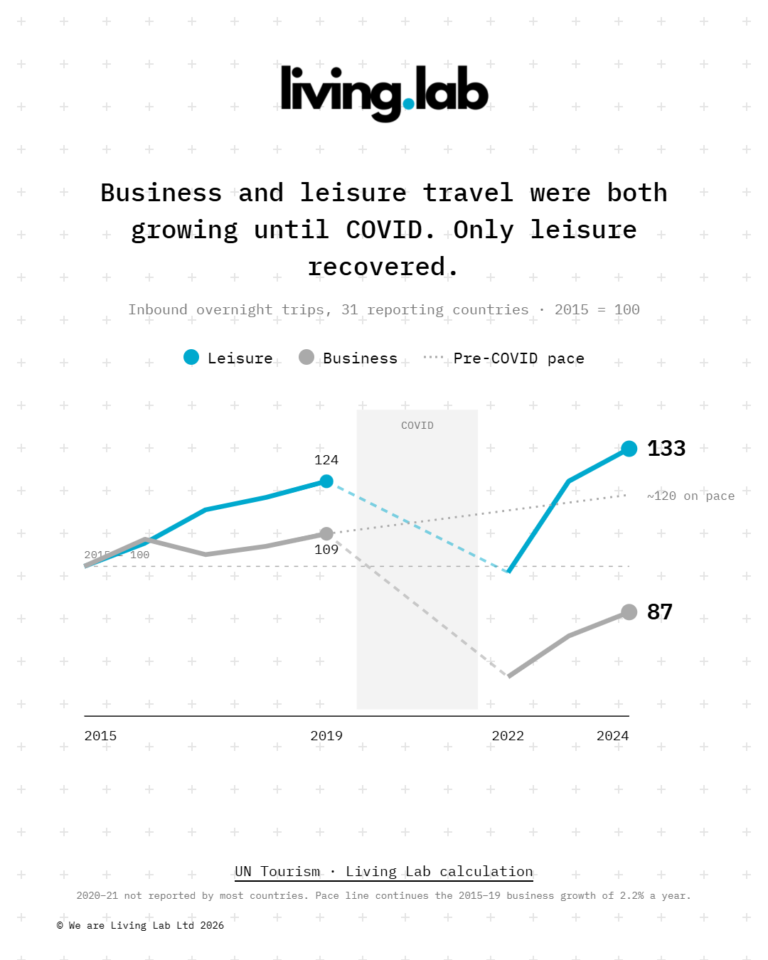
Business travel grew by 2.2% a year up to 2019 and leisure by 5.5% a year. Business was already a shrinking share of all trips, 13.3% in 2015 and 11.9% by 2019, but it was still growing. Then COVID stopped both.
Figure 1. Business and leisure travel were both growing until COVID. Only leisure recovered.
After COVID, leisure travel came back stronger than before
Leisure recovered quickly and has kept going. By 2024 it was 33% higher than in 2015. Business travel fell to 69% of its 2015 level and has only climbed back to 87%. If it had carried on growing at its old pace it would be at around 120 by now, so the real gap is bigger than a comparison with 2019 suggests.
By 2024, business made up just 9.1% of all trips. In 74% of the countries with business data, business visitors are still below their pre-COVID level. Among the biggest markets for business travel, those with more than 500,000 business trips in 2019, the figure is 87%.
Figure 2. After COVID, leisure travel came back stronger than before
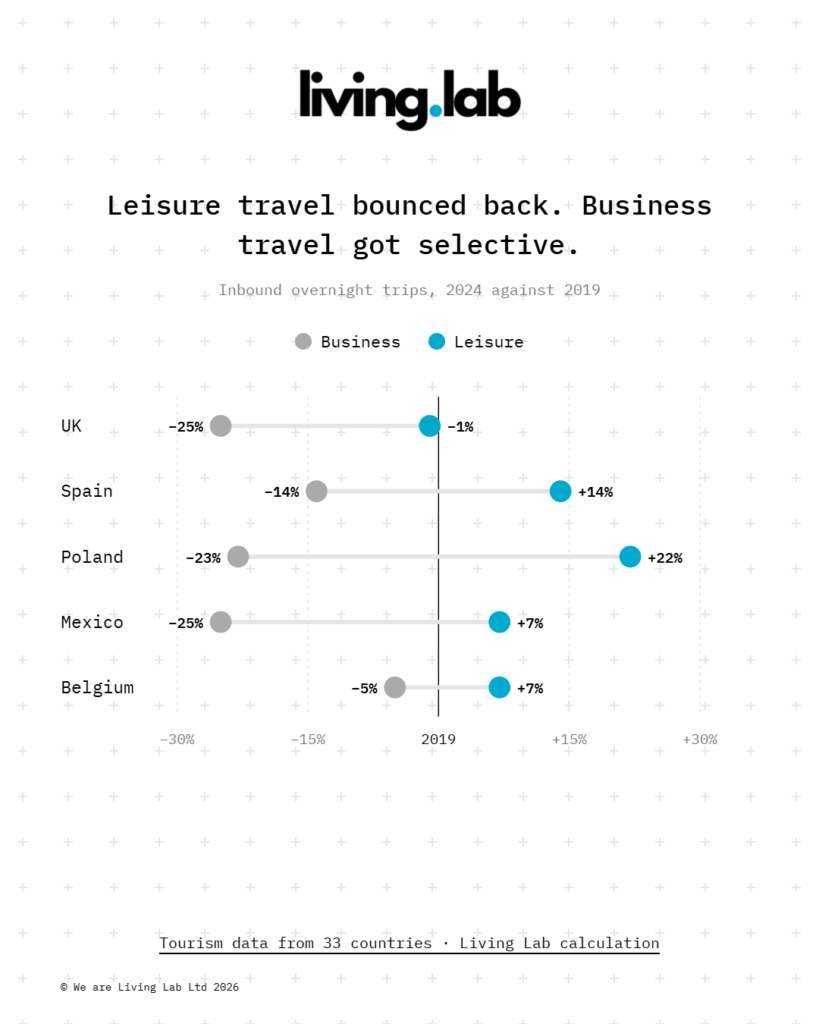
Since COVID, we are choosing video calls rather than business travel
We all learned to use Teams during lockdown, and most of us kept using it. For a company, every client check-in, supplier presentation or quarterly review held on a screen is a flight and a hotel it no longer pays for.
The Global Business Travel Association’s latest poll of travel buyers, taken in April, shows the pressure is still there. 82% name the cost of business travel as a concern for 2026, up from 70% in January, and 26% have moved some meetings or events online in the past three months. I don’t expect that kind of routine business travel to come back.
Conferences are where business travel is growing
Teams can’t put people in the same room, and that still matters. Human creativity thrives on the exchange of ideas, and ideas are best exchanged and developed face to face.
A study published in Nature in 2022 tested this with engineering teams in five countries. People working in person came up with more ideas than the same people working over video, because a screen narrows what people notice and share. The coffee before a session, the conversation in a corridor and the dinner that turns into a partnership all need people in one place.
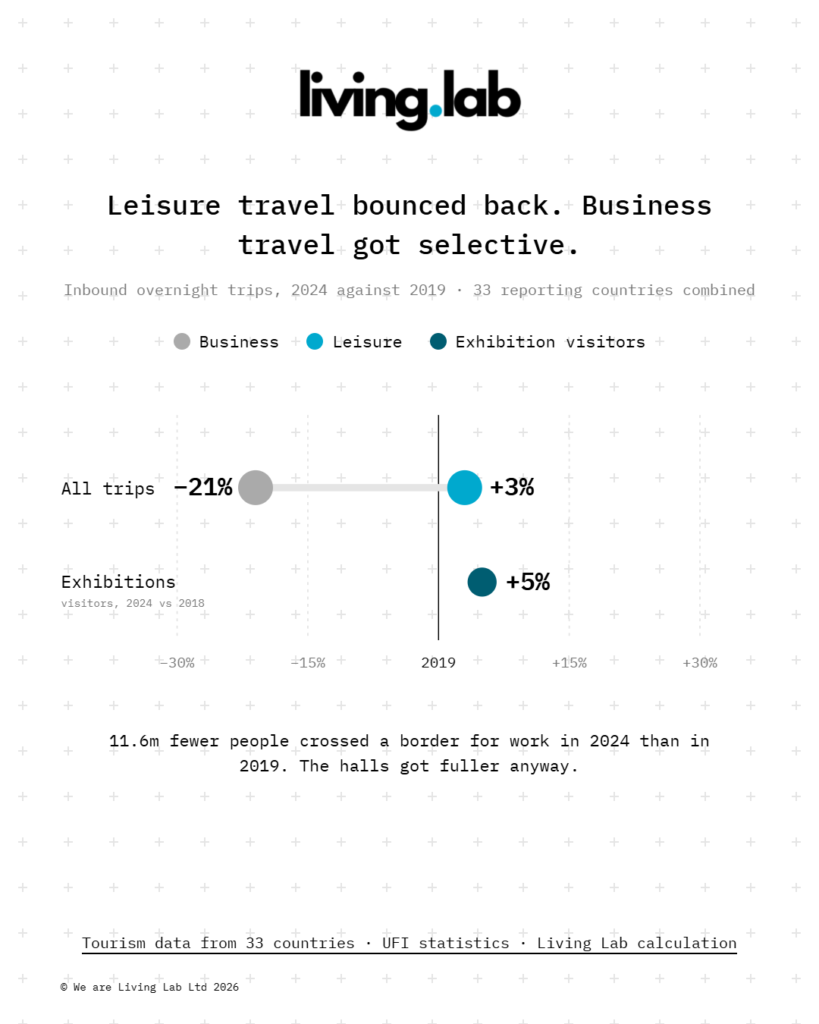
Travel buyers know it. In the same poll, 51% named conferences and trade shows among the hardest trips to move online, rising to 63% in Europe. UFI’s figures show 318m exhibition visitors in 2024 against 303m in 2018, up 5% over the same years that business travel fell by 21%.
The data has one limit worth knowing. Business trips are counted as a single category, so the sales call, the site visit and the congress sit together. We can see that the category shrank, but not which part of it. The exhibition visitor numbers are the best evidence we have that conferences grew.
Figure 3. Conferences are where business travel is growing
Business travel and leisure are blending together
COVID also changed what a business trip looks like. People add a weekend to the conference, bring the family along, or take the laptop to the coast and work from there for a month. The travel industry calls the first bleisure and the second the workation. Researchers now describe the workation as a new form of hybrid tourism that COVID accelerated.
That helps explain why the big events are thriving. If you fly to one conference a year instead of five client meetings, you want it somewhere worth staying, in a week worth staying for, like Cannes in June, Lisbon in November or Las Vegas in January. The conference gets you there, and the city keeps you a few extra days.
It also means some of the missing business travel is probably still happening, recorded as leisure. Someone working from Lisbon for a month, or adding four days to a congress, can easily be counted as a holiday visitor at the border. The data can’t separate them. For a city it makes little difference, because the money lands in the same hotels and restaurants either way.
Business conferences are turning into festivals
You can see it in the events themselves.
- Cannes Lions. The organisers reported record attendance in 2025. They say they want ‘the whole city to feel like it’s the festival’.
- CES in Las Vegas. Every launch at CES could be streamed, yet 148,392 people went in January, up 4% on the year and the biggest edition since COVID.
- Web Summit. More than 70,000 people and 2,700 startups came to Lisbon last November for its biggest edition, with events running across the city late into the night. Web Summit Qatar comes to Doha from 31 January.
- LEAP in Riyadh. More than 200,000 people attended in 2025, at a technology conference built from the start as a spectacle, with the city as the venue.
- GDC in San Francisco. The games industry’s annual gathering, where much of the business happens in the corridors and bars around the sessions.
- SXSW in Austin. Music, film and technology in one fortnight, with as much going on in the bars and streets as in the halls.
I think it’s a trend worth looking at hard.
How cities can grow from this
Fewer business visitors are coming, but more of them come for the same event in the same week. For anyone running a destination, that suggests four things.
- Count nights and spend rather than arrivals. The arrivals figure will keep looking weak while the value figure improves.
- Build the steady part of the calendar around nearby delegates. People who can arrive on a short flight are the easiest to bring back year after year.
- Treat the long-haul business visitor as a premium product. There are fewer of them, and they come for a reason.
- Sell the extra days. A delegate who stays for the weekend is worth more than one who flies home on Thursday.
Living Lab puts a city’s events, hotels, routes and visitor demand on one spine, so you can see which gatherings fill which weeks and what each one is worth. If you’re planning next year’s calendar, talk to us before the next bid goes in. To see where displaced travel demand has gone, read The US$50 billion tourism reallocation.
- A blog about travel, development, and the economy
La Sagra
Post COVID tourism recovery – Leisure travel bounced back. Business travel got selective.
We all learned to use Teams, and most routine business travel stopped. But ideas still come from people in a room together, over a coffee, in a corridor, at dinner. That is why business travel is 21% below 2019, exhibition visitors are up 5% and conferences are turning into festivals.
More rooms, or a better pattern of demand? The market that answers grows both.
A hotel pipeline decision is usually made on an occupancy trend, extrapolated forward. That answers a different question from the one a planner, a developer, or an investor faces: is the market short of rooms overall, or short of rooms on the 18 nights a year when demand peaks?
Price the route on the destination it grows, and it flies for years
A new route photographs well on launch day. Whether it is still flying in year three, without deep discounting, and still worth the airport incentive that started it, is a quieter question, and it is the one that comes up at renewal.
The US$50 billion tourism reallocation, and the destinations positioned to grow from it
International visitors to the United States fell 4.2% in 2025, the first annual decline since the pandemic, while worldwide travel grew. The spending did not disappear. It moved. Five economies are absorbing most of it, and the shift now looks structural.
Oman’s mountain destination: how a resort at 2,400 metres grows into three markets
Oman has announced plans for a high-altitude destination at Jabal al Akhdar, combining sports training, wellness, and tourism at 2,400 metres. It is the kind of project a Gulf government can commit to at once, and the kind that lives or dies on a demand case nobody has yet published.
Which destinations will grow from displaced US tourism demand?
International arrivals to the United States fell 4.2% in 2025 while worldwide travel grew about 4%. Living Lab’s displacement model puts the forgone spending at roughly US$50bn, and about US$10.6bn of it within reach of five economies. Each is limited by a different constraint.
- Powering the visitor economy
USE CASES
BY SECTOR
BY USE CASE
- Tourism R&D
Advancing the Tourism Industry
- Principles need instruments
- The test was the World Cup
- One system. The size of the prize